Choosing SUV shock absorbers from China requires more than comparing prices and attractive product photos. The right decision begins with vehicle fitment, driving conditions, and measurable performance. Search by the exact make, model, year, engine, suspension layout, and axle position. A shock absorber that fits physically may still deliver incorrect damping.
The practical question is simple: how to choose the right shock absorbers for my suv? Check the manufacturer’s OE references, dimensions, mounting style, piston-rod size, and rated load. Then consider your driving environment. City roads need controlled comfort. Gravel roads demand stronger sealing and better heat management. Towing requires stable damping under extra weight. Small details matter, such as oil leakage around the seal or uneven resistance during a hand test. Hand testing helps, but it cannot replace laboratory results.
Reliable Chinese suppliers should provide material specifications, production records, inspection reports, and warranty terms. Look for evidence of testing under heat, corrosion, vibration, and repeated compression. I would also request samples before approving a large order. A clean factory may still produce inconsistent batches. That is easy to overlook. Ask about quality control at every production stage, not only final inspection.
Check independent reviews, export experience, and communication speed. Technical answers should be precise, not vague. Certification can support credibility, but it does not prove perfect vehicle compatibility. Confirm standards for your target market and keep written records. The best supplier is not always the cheapest. It is the one that combines verified fitment, consistent damping, transparent documentation, and dependable after-sales support. Mistakes happen, so leave room for testing and reassessment.
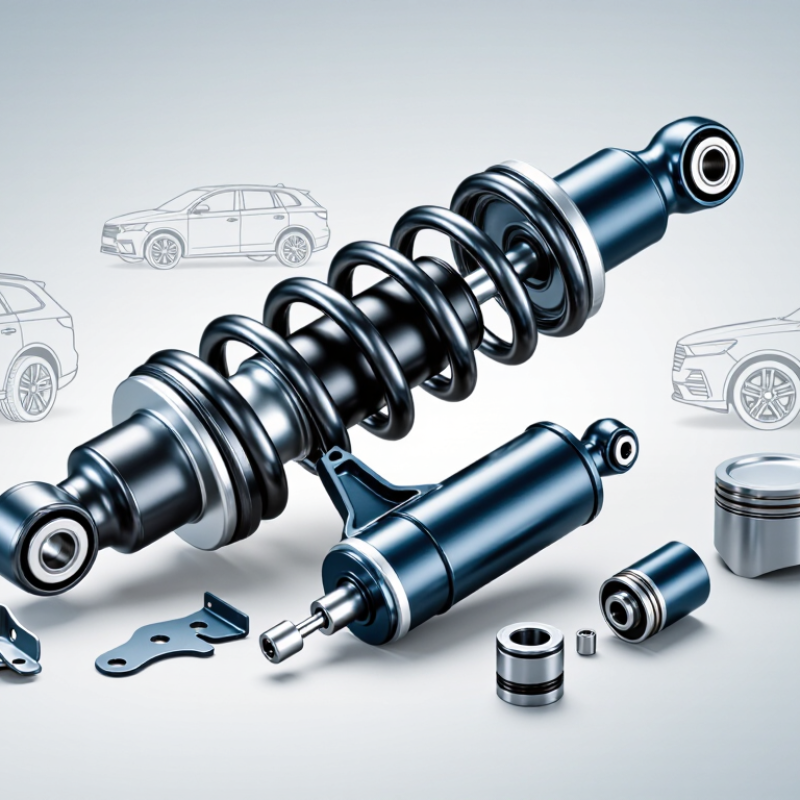
Choosing top SUV shock absorbers from China starts with understanding the shock type, not the lowest quotation. Twin-tube shocks place a working tube inside a reserve tube. They usually offer comfortable road manners and tolerate moderate impacts. However, their heat control can be weaker during repeated off-road compression. Monotube shocks use one larger body and separate gas chamber. They release heat faster and respond more consistently on rough trails. They may also transmit more road texture into the cabin.
Piston diameter deserves careful attention. A 30–36 mm piston can suit daily SUVs, light loads, and mixed city driving. A 40–46 mm piston generally provides stronger oil control for heavier vehicles or frequent towing. Bigger is not automatically better. My early assumption was wrong. Calibration, valve design, oil quality, and mounting strength matter just as much. Ask the supplier for dyno curves, piston measurements, seal specifications, and temperature testing. Request samples before approving a large order. Inspect welds, shaft chrome, bushings, and packaging at arrival. A reliable factory should provide batch traceability and consistent test records. Check the details. A shock can look impressive on a workbench yet perform poorly after twenty minutes on corrugated roads. Evaluate rebound and compression separately, then match them to tire size, payload, and driving conditions.
Choosing top SUV shock absorbers from China should begin with engineering targets, not catalog claims. SAE J670 helps define consistent vehicle-dynamics terms, including sprung mass, wheel rate, and damping. It does not prescribe one universal shock setting. Use it as a common technical language when discussing requirements with a supplier.
For many SUVs, a 1–1.5 Hz ride frequency provides a useful starting range for body comfort and control. Calculate it from the effective sprung mass and wheel rate at each axle. Then select a damping ratio, often around 0.25–0.40 for a comfort-focused road SUV. Convert that ratio into damping force using the suspension motion ratio. Do not copy passenger-car data blindly. An SUV’s roof height, tire stiffness, payload, and cargo changes can shift the result. My first estimate would usually be too soft without loaded-vehicle testing.
Tips: Ask for dyno curves at several piston speeds and temperatures. Check rebound and compression separately. Request results with the actual installation angle and motion ratio. Confirm performance after repeated cycles, not only at room temperature. A supplier should explain test conditions clearly. Small gaps in data deserve attention. Road testing should include empty, half-load, and full-load conditions, with notes on bounce, pitch, steering response, and impact harshness. Expect refinement; the first damping target is a measured hypothesis, not a finished answer.
Representative engineering targets for SUV suspension matching. SAE J670 terminology is used for sprung mass, wheel rate, suspension frequency, damping ratio, and damper force. Values are wheel-center equivalent targets and should be validated through vehicle testing.
| SUV Configuration | Estimated Sprung Mass per Wheel (kg) |
Target Ride Frequency (Hz) |
Calculated Wheel Rate (N/mm) |
Critical Damping ccrit (N·s/m) |
Rebound Damping Ratio ζr |
Compression Damping Ratio ζc |
Rebound Force at 0.3 m/s (N) |
Compression Force at 0.3 m/s (N) |
Recommended Evaluation Focus |
|---|---|---|---|---|---|---|---|---|---|
| Compact SUV, front axle | 450 | 1.10 | 21.7 | 6,250 | 0.25–0.35 | 0.10–0.18 | 469–656 | 188–338 | Check steering response, small-bump comfort, and rebound control. |
| Compact SUV, rear axle | 425 | 1.20 | 24.2 | 6,350 | 0.25–0.35 | 0.10–0.18 | 476–667 | 191–343 | Prevent rear axle float while maintaining acceptable empty-vehicle comfort. |
| Mid-size SUV, front axle | 525 | 1.20 | 29.9 | 7,920 | 0.25–0.35 | 0.10–0.18 | 594–831 | 238–428 | Balance body-motion control with braking dive and lane-change stability. |
| Mid-size SUV, rear axle | 500 | 1.30 | 33.4 | 8,885 | 0.25–0.35 | 0.10–0.18 | 666–933 | 267–480 | Verify wheel-hop resistance, cargo-load behavior, and road-joint comfort. |
| Large SUV, front axle | 600 | 1.30 | 40.0 | 9,800 | 0.25–0.35 | 0.10–0.18 | 735–1,029 | 294–529 | Prioritize pitch control, high-speed stability, and consistent damper output. |
| Large SUV, rear axle | 575 | 1.40 | 44.2 | 9,620 | 0.25–0.35 | 0.10–0.18 | 722–1,010 | 289–519 | Check loaded ride height, third-row comfort, and rear-impact absorption. |
| Heavy-duty SUV, front axle | 650 | 1.40 | 50.7 | 11,475 | 0.25–0.35 | 0.10–0.18 | 861–1,205 | 344–620 | Confirm thermal durability, high-load control, and resistance to fade. |
| Heavy-duty SUV, rear axle | 700 | 1.50 | 62.2 | 13,190 | 0.25–0.35 | 0.10–0.18 | 989–1,385 | 396–712 | Evaluate maximum payload, axle control, seal durability, and full-stroke protection. |
Choosing top SUV shock absorbers from China begins with accurate fitment, not attractive pricing. A VIN check can reveal the vehicle’s model year, engine type, suspension version, and factory configuration. Do not rely on a broad vehicle description alone. I once accepted a listing marked “fits all versions,” but the lower mounting width was different by several millimeters. The absorber looked correct. It was not.
Compare the supplier’s OE numbers with reliable catalog data and the original part label. Check piston rod length, compressed length, extended length, mounting style, and bushing dimensions.
Ask for clear measurement photos and a sample before placing a larger order. A simple test fit can expose interference near the tire or spring seat. It takes time. It prevents expensive returns.
VIN data may also be incomplete, so confirm it against the vehicle’s production date and suspension code when available.
ISO 9001 certification is useful, but it is not proof of perfect shock absorber performance. Request the certificate number, issuing body, validity period, and covered production scope. Then ask how incoming steel, seals, welding, oil filling, and final damping tests are recorded.
Batch traceability matters when a problem appears months later. I would also review inspection reports and warranty procedures.
Paperwork can look impressive. Factory controls still need verification. A small sample audit, dimensional check, and road test provide stronger confidence than documents alone.
Assessing a Chinese SUV shock absorber supplier requires more than checking test samples. IATF 16949 certification shows that an automotive quality system is independently audited. However, the certificate must match the actual production site and product scope. Ask for the certificate number, expiry date, certification body, and recent audit findings. A trading office may hold documents while another factory makes the parts. That gap matters.
ISO 14001 also deserves practical attention. The ISO Survey 2023 reported 529,853 valid ISO 14001 certificates worldwide. Certification does not prove perfect environmental performance, but it indicates controlled processes. During a factory audit, inspect oil storage, used-fluid collection, plating controls, and waste records. Look for clear labels, sealed containers, and workers who understand emergency procedures. Paperwork alone is weak evidence.
A serious audit should trace one damper from steel receipt to final testing. Check incoming material reports, heat-treatment records, seal inspection, welding controls, torque verification, and dyno-test curves. Request calibration records for force testers and dimensional gauges. Review PPAP files, capability studies, complaint records, and corrective-action reports. The IATF 16949 framework emphasizes risk control, customer-specific requirements, and continual improvement. Still, certificates can become outdated. I have seen impressive documents paired with inconsistent line discipline. Allow time for an unannounced production-floor walk, and compare sample results with serial-number records before approving a supplier.
How to Choose Top SUV Shock Absorbers from China?
Durability should begin with measurable evidence, not polished catalogs. Ask suppliers to run ISO 2631-1 vibration evaluations on a complete SUV or representative suspension fixture. This standard assesses whole-body vibration exposure, including acceleration across frequency ranges. It does not define a shock absorber pass-or-fail limit. That detail matters.
Request test records showing road-load inputs, temperature, payload, frequency, and mounting conditions. Then examine force-velocity curves before and after testing. A stable curve suggests controlled damping. Excessive leakage, seal swelling, or reduced rebound force signals trouble. The 2024 J.D. Power U.S. Vehicle Dependability Study reported 190 problems per 100 vehicles, reinforcing the cost of overlooked durability issues.
A 100,000-cycle trial offers stronger component evidence. However, cycle count alone proves little. Specify piston speed, stroke length, side load, oil temperature, and pause intervals. Ask for measurements every 10,000 cycles, not only a final certificate. Compare damping loss against the original curve. Inspect the rod surface under magnification.
A pass is not perfection.
Real roads add potholes, mud, salt, and uneven loading. ISO 2631 results may describe cabin vibration better than internal wear. I would still request a mixed-profile road simulation and independent laboratory verification. Suppliers that disclose failed samples appear more credible than those showing flawless charts. Reliability often hides in the uncomfortable details.
Twin-tube designs use a working tube inside a reserve tube. They usually provide comfortable road behavior.
A 30–36 mm piston often suits daily driving, light loads, and mixed city roads.
Request dyno curves, piston measurements, seal specifications, and temperature test records.
Provide the vehicle identification number, production date, suspension code, and original equipment numbers.
No. It shows a quality management system, not perfect damping performance.
Inspect welds, shaft chrome, bushings, mounting points, and packaging.
Request vibration evaluations using ISO 2631-1 methods on a vehicle or representative fixture.
It provides useful component evidence, but cycle count alone proves little.
Choosing top SUV shock absorbers from China requires a structured evaluation of design, compatibility, quality, and durability. Start by understanding the main shock types, including twin-tube and monotube designs, and compare piston sizes commonly ranging from 30 to 46 mm. Define damping targets according to vehicle weight, suspension layout, and typical SUV ride frequencies of 1–1.5 Hz, using SAE J670 terminology where appropriate. To answer “how to choose the right shock absorbers for my suv,” confirm fitment through the VIN, original equipment numbers, dimensions, mounting points, and documented ISO 9001 quality procedures.
Supplier evaluation is equally important. Look for manufacturers with IATF 16949 and ISO 14001 systems, transparent production records, and positive factory audit results. Before purchase, request evidence of ISO 2631-based vibration testing, performance checks, and durability validation involving at least 100,000 operating cycles. These steps help ensure the selected shocks deliver reliable control, consistent comfort, proper fit, and long-term service performance.

DC-Link Auto